
Course prefix and number: ITSM 1033
Course Title: AI Workplace Applications
Credit hours: 3 Credits
Lecture hours: 2
Clinical/Lab hours: 2
Semester: Spring 2026
Catalog description
This course introduces students to the basics of Artificial Intelligence (AI) and how it is used in business. Students will learn about AI technologies like machine learning, neural networks, and natural language processing. The course shows how these tools are changing the way businesses operate, make decisions, and compete. Through real-world examples, students will discover how AI can help solve business problems and create new opportunities. No prior experience with AI or business is needed.
Prerequisite:
No Prerequisites
Course Information
Course Outcomes
At the end of this course, students will be able to:
- Explain foundational concepts of AI, machine learning, and neural networks, and articulate their significance in the modern business landscape.
- Analyze real-world business scenarios to identify opportunities for AI integration, such as process automation, customer insights, or predictive analytics.
- Compare and contrast different machine learning models and algorithms, and justify the selection of appropriate models for specific use cases.
- Demonstrate an understanding of how AI systems utilize big data, including methods for classification, clustering, and decision-making support.
- Describe the components and functioning of artificial neural networks, and evaluate their application in areas like speech recognition or text analysis (e.g., NLP).
- Assess ethical and legal implications of AI technologies, including data privacy, algorithmic bias, and transparency in automated decision-making.
- Apply AI and data science principles to solve business problems using tools, flowcharts, and frameworks introduced in the course.
- Collaborate and communicate effectively with technical teams, leveraging AI knowledge to support cross-functional decision-making and IT initiatives.
Topical Outline
- Key concepts and terminology related to Artificial Intelligence (AI), Machine Learning (ML), neural networks, and data science within the context of modern business environments.
- Common business applications of AI.
- Various machine learning approaches (e.g., supervised, unsupervised, reinforcement learning) and assess their suitability for specific business problems.
- Structure and function of artificial neural networks, and analyze their role in solving complex data-driven challenges, including image and language processing.
- AI and big data, including how AI methods are used for data classification, clustering, and enhancing decision support systems.
- Ethical, legal, and operational considerations in the implementation of AI technologies, including issues of bias, transparency, and data privacy.
- AI concepts in real-world business scenarios, using case studies and practical exercises to analyze problems and propose solutions.
- Applying foundational AI knowledge to communicate needs, interpret results, and support AI-related projects.
Faculty Contact Information
Courtney Stewart
Adjunct Professor
815-295-6605
cstewart@kcc.edu
Paul Carlson
Dean - Business, Technology & Human Services
815-802-8858
pcarlson@kcc.edu
Division Office
W102
815-802-8850
Course Information
Additional Textbook/s and Course Materials
UCertify: Artificial Intelligence for Business
Artificial Intelligence for Business, 2nd edition
Published by Pearson FT Press (December 14, 2020) © 2021 Doug Rose
Additional Methods of Evaluation
Student evaluation is based on points accrued via Virtual Labs, Quizzes, and Exams. Point values may change based on added or removed assignments.
- Readings – 30%
- Labs – 30%
- Quizzes – 20%
- Final Exam – 20%
The corresponding grading scale will be:
- 90-100% = A
- 80-89% = B
- 70-79% = C
- 60-69% = D
- 59% or lower = F
Business, Technology & Human Services
Dean, Paul Carlson; 815-802-8858; V105; pcarlson@kcc.edu; Division Office – W102; 815-802-8650
Course Policies
- Attendance Policy
- Attendance is MANDATORY
- If a class/lab session must be missed, arrangements must be made prior to the absence.
- If an absence is not planned, a valid excuse (i.e., doctor’s note, etc.) must be provided to the instructor for each missed session at the beginning of the following class session.
- Make-up work, including quizzes, exams, etc., is provided at the discretion of the instructor and must be completed within one week of the missed class period.
- Readings
- This course requires you to read the assigned reading from the instructor
- Lectures will provide only an overview of the reading material.
- You are expected to come to class prepared for that day’s lecture
- Quizzes, Labs & Exams
- Primary communication will be via Canvas and email.
- Instructor will respond to messages within 48 hours (weekdays) and grade assignments within one week of submission.
- Students should maintain respectful, professional communication at all times.
- Quizzes are meant to assess your recall and retention of readings and assignments
- Exams are designed to assess retention of lecture and reading materials, while also assessing your ability to compare /contrast and apply concepts.
- On face-to-face quiz and exam days, students must arrive on time and be ready to take the quiz or exam at the start of class.
- If a student enters the classroom late on a quiz day, he/she may take the quiz as long as at least one student is still in possession of the quiz. If all students have completed and turned in the quiz, he/she may not take the quiz.
- Students will not be permitted to enter the classroom and take the exam once the exam has started.
- Once an exam or quiz has been administered, a student will not be permitted to leave for any reason until he/she turns the exam in.
- If a student’s cell phone is disruptive during an exam or quiz, the student will receive a zero on that exam.
- If a student is found using their cell phone in any way during an exam or quiz, it will be considered to be a case of cheating and the student will receive a zero on the exam as well as the possibility of receiving an F for the course grade.
- Late assignments will not be accepted unless arrangements are made
- Cell Phone Use
- Turn off all cell phones and all other items that may beep, buzz, or otherwise interrupt the instructor and other students.
- If you must have your cell phone on for work or a family emergency, set it to vibrate and leave the classroom if you receive a call.
- No texting during class.
- Failure to follow any of the above rules will result in a warning (first offense), 5 point deduction from your class grade (second offense), and removal from the class period (third and beyond offense).
- Artificial Intelligence (AI) Use
- Students must obtain permission from the instructor before using AI composition software / AI writing tools / AI tools (such as ChatGPT) for any assignments in this course.
- Using these tools without the instructor’s permission places your academic integrity at risk.
- If AI tools are used, students are expected to demonstrate transparency and provide appropriate citations for any AI-generated content included in their work.
- Other Classroom Guidelines
- Use respectful, professional language in all discussions and emails.
- Avoid using ALL CAPS, slang, or inappropriate language.
- When replying to peers, provide constructive feedback.
- You will gain the most from this course if you actively participate in classroom discussions and share your experiences and questions.
- Learn the names of your classmates and help one another whenever possible (but not during quizzes and exams).
- Take responsibility for the classroom and lab areas by picking up after yourself.
- Arrive promptly before class begins.
- No tobacco products may be used on campus.
- Do not come to class when you are ill and likely to infect others.
- Minor children are not allowed in the classroom or lab areas for safety reasons.
- No students will be allowed to work in lab areas outside of class time without instructor permission and appropriate supervision.
- Student Integrity
- All students are expected to take quizzes, exams, write papers, and conduct themselves with integrity, common sense, and respect for their fellow students, the instructor, and the academic institution.
- Students should not jeopardize their own honesty or that of other students.
- Cheating will not be tolerated.
- Upon evidence of student cheating, the student will be dropped from the course and receive a grade of F in the course
College Policies, Resources and Supports
College Policies
For information related to the Student Code of Conduct Policy, Withdrawal Policy, Email Policy, and Non-Attendance/Non-Participation Policy, please review the college’s Code of Campus Affairs and Regulations webpage, which can be found at.
Resources
KCC offers various academic and personal resources for all students. Many services are offered virtually, as well as in person. Please visit Student Resources - Kankakee Community College to access student resources services such as:
- Clubs and organizations
- Counseling and referral services
- Office of disability services
- Student complaint policy
- Transfer services
- Tutoring services, etc.
Copyright and Syllabus Disclaimer
The materials on this course are only for the use of students enrolled in this course for purposes associated with this course. Further information regarding KCC's copyright policy is available at https://kcc.libguides.com/copyright.

College Policies, Resources and Supports
For information related to the Student Code of Conduct Policy, Withdrawal Policy, Email Policy, and Non- Attendance/Non-Participation Policy, please review the college’s Code of Campus Affairs and Regulations webpage, which can be found at catalog.kcc.edu under the Academic Regulations & Conduct Guide.
KCC offers various academic and personal resources for all students. Many services are offered virtually, as well as in person. Please visit Student Resources - Kankakee Community College to access student resources services such as:
- Clubs and organizations
- Counseling and referral services
- Office of disability services
- Student complaint policy
- Transfer services
- Tutoring services, etc.
The materials on this course are only for the use of students enrolled in this course for purposes associated with this course. Further information regarding KCC's copyright policy is available at https://kcc.libguides.com/copyright.
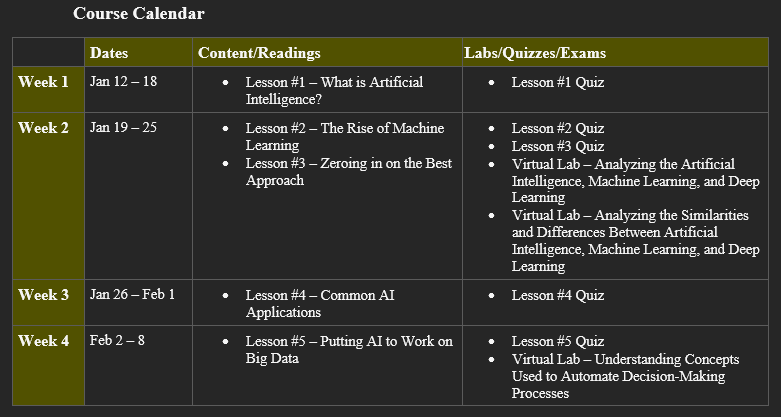
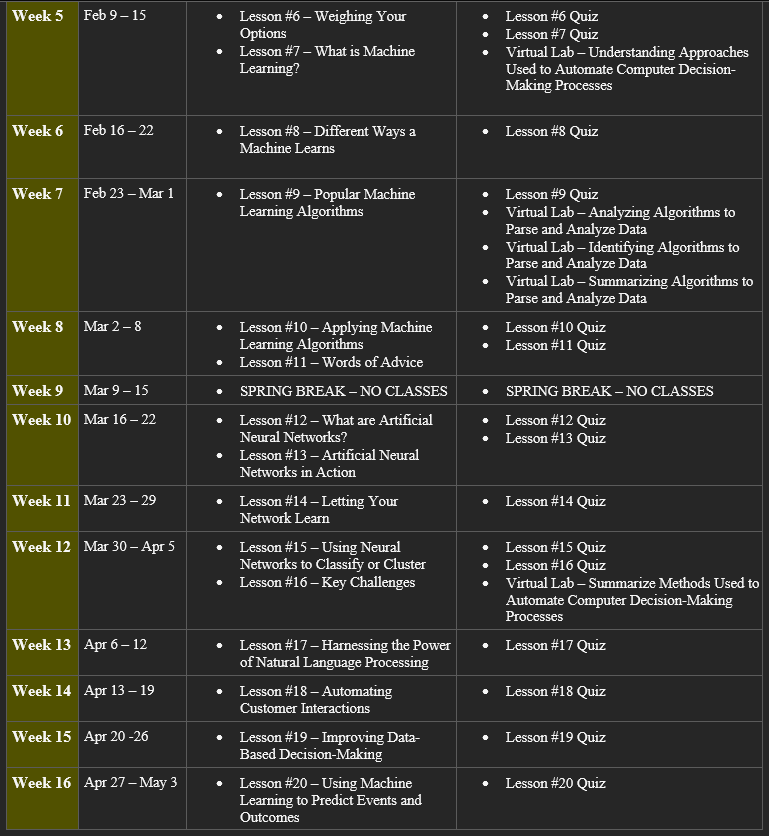
|Course syllabus/calendar is subject to change.