
Thursday Nights
5:30-9:30pm
The student will identify the materials used in semiconductors. He or she will demonstrate an understanding by explaining how electrons and holes flow in semiconductors. He or she also will describe basic amplifier configurations, explain how to bias amplifier configurations, and calculate the gain and stability for bipolar and unipolar devices. Basic components must be purchased by the student.
General Education Outcomes are the knowledge, skills, abilities, attitudes, and behaviors that students are expected to develop as a result of their overall experiences with any aspect of the college, including courses, programs, and student services, both inside and outside of the classroom. The General Education Outcomes specifically learned in this course are:
- Communication
- Critical Thinking
Faculty Contact Information
Tues/Thurs 9-11am
Course Information
At the end of this course, students will be able to:
- Develop the ability to analyze basic electronic devices.
- Develop the ability to appropriately select and properly use basic electrical measuring devices in making common electrical measurements.
- Develop the ability to read and interpret electronic schematic wiring diagrams.
- Develop basic skills in the use of tools and materials of the electrical and electronics industry and safe work habits and techniques in the use of electrical equipment.
- Semiconductor Materials
- Familiarization and PN Junctions
- Diode Theory and Circuits
- Special Purpose Diodes Zener
- Regulated Power Supplies
- BJT Fundamentals
- BJT Biasing
- JFETS Field Effect Transistors
- Op Amp Circuits
- Oscillators & Multivibrators
- Thyristors
Semiconductor Devices – Theory and Application, by James M. Fiore
Semiconductor Devices Laboratory Manual, by James M. Fiore
Student achievement in the classroom phase of the course will be evaluated on the basis of homework,
quizzes, mid-term and final. Achievement in the laboratory will be evaluated on the basis of the accuracy
and completeness of reports of laboratory activities and of skills developed in the performance of
manipulative tasks as evidenced by the workmanship demonstrated in the laboratory assignments. A
laboratory midterm and/or final examination may be administered.
NOTE: The following evaluation method may be modified by the instructor as required. Letter grades are
determined by the following percentage:
BELOW 71 = F
71 - 77 = D
78 - 84 = C
85 - 92 = B
93 - 100 = A
In the determination of the final mark in the course, the various items will be weighted as follows:
Homework: 5%
Quizzes: 20%
Labs: 20%
Midterm Lab Exam: 20%
Final Exam: 20%
Project: 15%
Business, Technology & Human Services
Dean, Paul Carlson; 815-802-8858; V105; pcarlson@kcc.edu; Division Office – W102; 815-802-8650
ATTENDANCE: You need to be in class. Students with poor attendance generally do not do well in this course. Students who show up every week generally do. You are required to notify the instructor via email prior to class if you are unable to attend. Missed quizzes / labs without email notification prior to class will result in a score of 0 being entered without the opportunity to make up the work. See Late Work Policies below.
TARDINESS: Class starts promptly at 9am (Section 010), 3:15pm (Section 020), or 5:30pm (Sections 810 & 820). You are required to notify the instructor via email prior to class if you will be late. If you are late to class, you will miss the opportunity to ask questions prior to the weekly quiz. Once the weekly quiz starts, you will be denied entry into the classroom until everyone completes their quiz. If you miss a quiz because you are late to class, a score of 0 will be entered for that quiz. See Late Work Policies below.
NOTE: If a student has missed more class hours than the number of credit hours to be earned in the class, the instructor may record the grade of "F" for the course. Missed classes may not be made up without prior permission from the instructor. Failure of the student to attend class does not constitute withdrawal. A formal written withdrawal must be made by the student to the Office of Admissions and Records.
CELL PHONES: THE USE OF CELL PHONES, EARBUDS, OR OTHER ELECTRONIC DEVICES ARE NOT PERMITTED DURING CLASS OR LAB. If there is an emergency, please leave the classroom prior to taking the call as a courtesy to other students. All personal electronics, such as cell phones/tablets/computers/earbuds/headphones, etc. must be stowed out of sight during quizzes and exams.
LAB SAFETY: School code requires that safety glasses or some other approved form of eye protection be worn in the laboratory at all times. It is recommended that you find and purchase a pair you find comfortable wearing for extended periods.
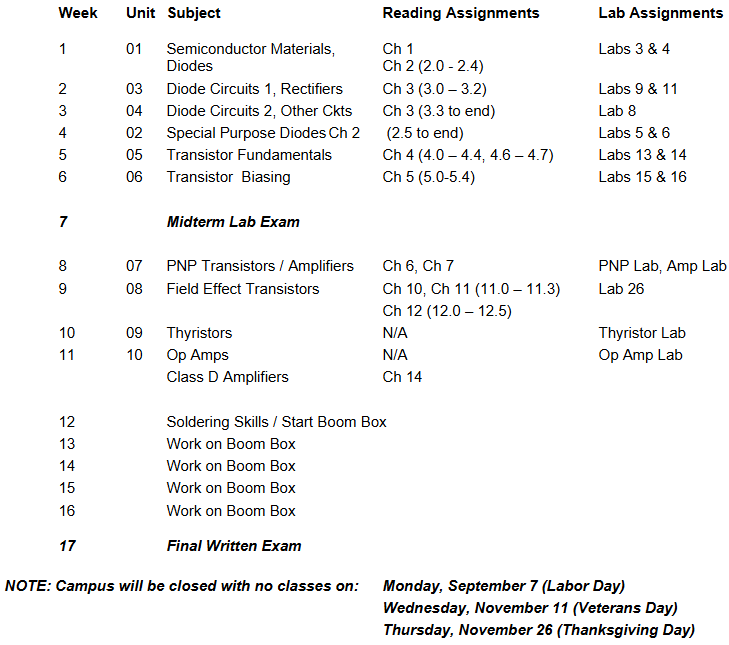
READING ASSIGNMENTS: Weekly reading assignments are listed on the Course Syllabus. Each Unit’s reading assignment are also identified in the Unit Module.
The textbook for this course, Semiconductor Devices – Theory and Application by James M. Fiore, is an Open Educational Resource. A pdf of the textbook is provided in the Canvas Course Information Module at no cost to the student. A paperback copy of the textbook is available for purchase from Amazon for about $21. The KCC Bookstore will also have a limited number available for purchase at a slightly higher price. The companion Lab Manual is required and is available for ≈ $12 in the KCC Bookstore or from Amazon.
LECTURES: Lectures will be standard PowerPoint presentations. Handouts of the slides will not be provided. PDF versions of PowerPoints lectures are available for you to review in the Unit Module. In some cases, videos of previous years’ lectures may also be available.
QUIZZES: Quizzes are administered promptly at the start of each class period over the previous week’s material. You may ask questions about the material prior to the quiz, and you are highly encouraged to do so. The instructor reserves the right to administer an alternative quiz for missed quizzes. See Late Work Policies below.
LABS: Students will work on their labs with a lab partner. Lab partners will be decided at random each week. Each student should strive to understand the lab and be comfortable performing the lab independently. A Midterm Lab Exam will be given to ensure students are fully engaging in lab activities. Lab completions are due at the end of each lab period. To receive credit for a lab completion signoff, the instructor MUST SEE the lab circuit assembled and functioning along with the completed documentation. A student with an incomplete lab who leaves prior to the end of the class period will receive a 0 for that lab. Labs will NOT be accepted late without prior approval from the instructor. See Late Work Policies below for more information regarding late labs.
A maximum of 2 missed labs can be made up in the Tutor
Lab. The tutor must observe your assembled and functioning lab circuit, and all data and questions must be completed. See Late Work Policies below.
HOMEWORK: Homework assignments are due at the start of class one week after the lecture over that material. See Late Work Policies below.
PROJECT: During the last few weeks of this course, you will learn how to solder electronic components onto a circuit board, and you will build your own Bluetooth Boom Box. You will be required to purchase an inexpensive craft / ammo box for your Boom Box. All other materials will be provided by KCC. During project work, you are required to be in class and on time until your project is completed.
LATE WORK POLICIES:
You are required to notify the instructor via email prior to class if you will miss
class or if you will be late to class. If you miss any work (quiz, lab, or exam) because you did not attend or were late to class, and you did not notify the instructor via email prior to the start of class, the missed work will receive a score of 0 and cannot be made up.
If you email the instructor prior to the start of class that you cannot attend or will be late the following rules apply: 1) a maximum of 3 missed quizzes can be made up, 2) a maximum of 2 missed labs can be made up; 3) the missed quizzes or labs must be made up within the next 7 days at a date and time agreeable to both the student and the instructor. It is up to the student – not the instructor – to negotiate a time to make up the quiz or lab. After 7 days, a 0 will be entered and the work cannot be made-up. Once a student reaches the maximum number of missed quizzes (3) or labs (2), missed work cannot be made up and will result in a score of 0 points.
Homework assignments are due at the start of class on the due date. Late assignments will automatically receive an 8% per day late penalty for up to 7 days (50% max penalty). After 7 days, a 0 will automatically be entered and the homework assignment cannot be made up.
College Policies, Resources and Supports
For information related to the Student Code of Conduct Policy, Withdrawal Policy, Email Policy, and Non- Attendance/Non-Participation Policy, please review the college’s Code of Campus Affairs and Regulations webpage, which can be found at catalog.kcc.edu under the Academic Regulations & Conduct Guide.
KCC offers various academic and personal resources for all students. Many services are offered virtually, as well as in person. Please visit Student Resources - Kankakee Community College to access student resources services such as:
- Clubs and organizations
- Counseling and referral services
- Office of disability services
- Student complaint policy
- Transfer services
- Tutoring services, etc.
The materials on this course are only for the use of students enrolled in this course for purposes associated with this course. Further information regarding KCC's copyright policy is available at https://kcc.libguides.com/copyright.
|Course syllabus/calendar is subject to change.