
Mondays & Wednesdays: 10-10:50am
General Education Outcomes are the knowledge, skills, abilities, attitudes, and behaviors that students are expected to develop as a result of their overall experiences with any aspect of the college, including courses, programs, and student services, both inside and outside of the classroom. The General Education Outcomes specifically learned in this course are:
- Critical Thinking
- Responsibility
Faculty Contact Information
Mondays & Wednesdays: 1:50-3:20pm
Tuesdays: 10am-12pm online (in-person by appt.)
Professor Jessica Jaenicke
Course Information
At the end of this course, students will be able to:
- Evaluate their strengths and weaknesses as college students.
- Identify strategies for managing their time, money, and stress.
- Demonstrate effective communication skills appropriate to the situation.
- Apply critical thinking and problem solving skills in a variety of contexts.
- Demonstrate proficiency in a variety of study skills.
- Develop effective and ethical strategies for locating, evaluating, and using information to inform their ideas.
- Articulate what it means to become a learner.
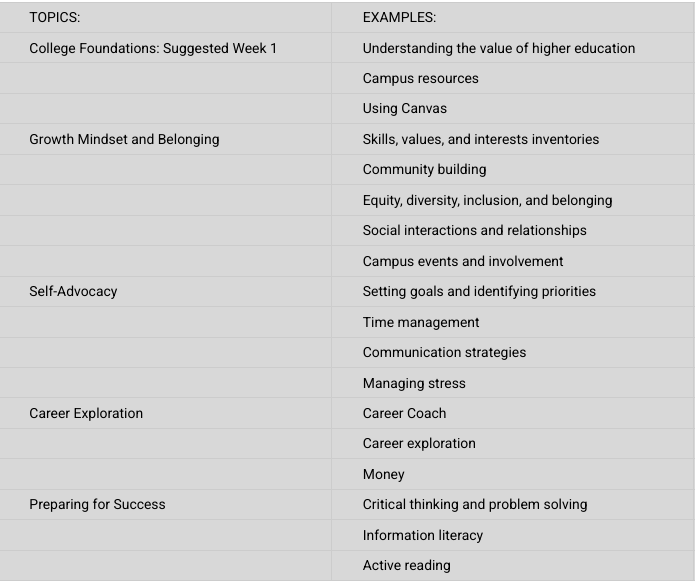
| TOPICS: | EXAMPLES: |
| College Foundations: Suggested Week 1 | Understanding the value of higher education |
| Campus resources | |
| Using Canvas | |
| Growth Mindset and Belonging | Skills, values, and interests inventories |
| Community building | |
| Equity, diversity, inclusion, and belonging | |
| Social interactions and relationships | |
| Campus events and involvement | |
| Self-Advocacy | Setting goals and identifying priorities |
| Time management | |
| Communication strategies | |
| Managing stress | |
| Career Exploration | Career Coach |
| Career exploration | |
| Money | |
| Preparing for Success | Critical thinking and problem solving |
| Information literacy | |
| Active reading |
Bhargava, Rohit and Jennifer Brown. Beyond Diversity. Ideapress Publishing. (2021).
There is no textbook used in this course. All materials used will be provided to you.
A variety of assignments will be given throughout the course, including shorter assignments such as discussion board posts and re ection papers, and longer assignments, such as time management and career exploration activities. Points are listed with each assignment and totaled over the course of the semester. Turning in assignments is essential to receiving a passing grade. Grades will be given on the following scale
| Points | Grade |
| 100-90% | A |
| 89.9-80% | B |
| 79.9-70% | C |
| 69.9-60% | D |
| Below 60% | F |
1. Student Passport to Online Learning
2. LASSI Inventory
3. Information Literacy
4. Career Exploration and Academic Mapping
5. Campus Event Participation (2)
6. Financial Literacy
7. Diversity, Equity, Inclusion, and Belonging writing assignment
Liberal Arts & Sciences
Dean, Jennifer Huggins; 815-802-8484; R310; jhuggins@kcc.edu; Division Office- W102; 815-802-8700
Student Support Hours: I encourage all of my students to reach out to me when they have questions, concerns, or a desire for additional support in my classes. If you need to meet outside my scheduled times, please email me to request a weekday appointment (with at least 24 hours advance notice). Also let me know if you prefer to meet virtually) or on-campus.
- submitting someone else’s work and/or AI-generated or AI-assisted writing tools
- using published material (including materials published online) without proper attribution
- paraphrasing or quoting someone without attributing the quote in your paper with a correct in-text citation, even if the source is included on the works cited page; improper paraphrase (sometimes referred to as “synonym swapping”) may also be plagiarism if the attempted paraphrase too closely imitates the writing style (including syntax) of the original source
- failing to clearly indicate when you are using quoted materials by not including (or properly formatting) quotation marks
- working with someone (without my permission) to write your paper and presenting it as your own
RESPECT.
Yourself, your peers, me, our time, your opportunity to learn, ALL OF IT!
College Policies, Resources and Supports
For information related to the Student Code of Conduct Policy, Withdrawal Policy, Email Policy, and Non- Attendance/Non-Participation Policy, please review the college’s Code of Campus Affairs and Regulations webpage, which can be found at catalog.kcc.edu under the Academic Regulations & Conduct Guide.
KCC offers various academic and personal resources for all students. Many services are offered virtually, as well as in person. Please visit Student Resources - Kankakee Community College to access student resources services such as:
- Clubs and organizations
- Counseling and referral services
- Office of disability services
- Student complaint policy
- Transfer services
- Tutoring services, etc.
The materials on this course are only for the use of students enrolled in this course for purposes associated with this course. Further information regarding KCC's copyright policy is available at https://kcc.libguides.com/copyright.
|Course syllabus/calendar is subject to change.