
Every Other Tuesday Beginning August 25th
1-5:30 pm
The course encompasses an in-depth study and understanding of the physiologic and biochemical processes operant in both health and illness. The student will perform analyses on various body fluids, grouped according to function of organ system and will be able to apply and explain the chemical principles, physiologic and chemical changes, and the clinical interpretation of their results. Understanding the theory and application of laboratory instruments (including computers or laboratory information systems), laboratory math, quality control, and laboratory safety is emphasized.
General Education Outcomes are the knowledge, skills, abilities, attitudes, and behaviors that students are expected to develop as a result of their overall experiences with any aspect of the college, including courses, programs, and student services, both inside and outside of the classroom. The General Education Outcomes specifically learned in this course are:
- Communication
- Critical Thinking
- Responsibility
Faculty Contact Information
Tuesday Before Lab 9am-1pm
Virtually Monday 8am-3pm by appointment.
Course Information
At the end of this course, students will be able to:
- Perform with accuracy the analytical tests required in this course, using quality control procedures and safety techniques.
- Recognize limitations, sources of error, and interfering substances for the analytical tests and take corrective action when possible.
- Relate/correlate information to disease or non-disease processes in reference to clinical chemistry.
- Apply technology by operating computers/instruments, maintaining equipment, and troubleshooting when necessary.
- Utilize basic skills in mathematics by calculating results, determining concentrations and dilutions of solutions, converting units of measure and applying statistical computation and analysis for quality control programs.
- Basic Principles & Practice
- Quality Improvement (LEAN Six Sigma)
- Immunochemical Techniques
- Nonprotein Nitrogen Compounds
- Amino Acids & Proteins
- Lipids & Lipoproteins
- Enzymes
- Liver Function
- Electrolytes
- Blood Gases, pH, and Buffer Systems
- Cardiac Markers
- Hypothalamic & Pituitary Function
- Therapeutic Drug Monitoring & Toxicology
- Tumor Markers
- Thyroid Gland
- Pancreatic & GI Function
- Body Fluid Analysis
Textbook:
Clinical Chemistry Principles, Procedures, Correlations, 9th Edition by Bishop, Fody, Shoeff
KCC Lab Manual
Closed Toe Shoes
Lab Coat
GRADE CALCULATION
A. Exams 65%
B. Labs 15%
C. Assignments 10%
D. Final exam 10%
93-100 A
84-92 B
75-83 C
NOTE: A MINIMUM OF 75% MUST BE MAINTAINED TO RETAIN ELIGIBILITY FOR THE MEDICAL TECHNOLOGY PROGRAM
Health Careers
Dean, Brad Wood; 815-802-8815; M107; bwood@kcc.edu; Division Office – W102; 815-802-8800
Cell phones: using and sending/receiving text messages will be perceived as a classroom interruption and will be counted as an absent and loss of in class points. If phone usage is necessary for an emergency, please quietly step out of the classroom.
Student Responsibility:
Students are responsible for all material presented or assigned online and during labs.
If a student is unable to attend all or part of a lab session, that student is responsible for obtaining any information that he or she missed from one of his or her classmates. Students are responsible for the contents of the course.
Students should plan to direct questions to the instructor about course policies or topics to be covered on tests in a timely fashion.
Instructor Responsibility:
The instructor will return any emails Monday through Friday with 24 hours. Emails received on Saturday and Sunday will be answered on Monday.
The instructor may be unable to respond to questions posted the night before or day that a course requirement is due.
The instructor, as well as the department staff, are not available to answer questions over holidays and days that the school and the school’s science once are closed.
The instructor will grade all assignments within 2 – 3 days.
Laboratory Safety
No food or drink allowed in the classroom or M139 lab.
Clean countertops before and after class as necessary.
All students must wear a lab coat, gloves, and closed toe shoes during labs that require the use of biological specimens.
Any accident must be reported to the instructor immediately.
Absolutely no lab equipment or supplies are permitted to be used outside of M139. No exceptions.
Follow all instructions for needle, sharps, and bio-hazardous material disposal. Any breach in safety procedures can put everyone in the classroom at risk. Serious or repeated breaches of any safety instructions during any lab exercise can result in a student’s dismissal from the class. Students dismissed from class will be counted as absent and will not receive any applicable points for that lab.
The instructor must be present when students are performing procedures.
No small children are allowed in the classroom or lab at any time for any reason. This policy is for the safety of the children and must be strictly adhered to.
- Permitted uses: brainstorming, generating questions, receiving feedback, exploring alternative explanations, and other instructor-approved uses.
- Integrated AI activities: when assigned, students may use AI to generate or analyze material and then critique its accuracy, assumptions, biases, and limitations.
- Disclosure: students briefly identify which AI tool they used, what they used it for, and how they incorporated or modified its output.
- Human responsibility: students are responsible for the accuracy, originality, citations, and reasoning in their submitted work—even when AI was involved.
- Verification: students should independently verify factual claims, citations, calculations, quotations, and other AI-generated information.
- Privacy: students should not enter confidential, personally identifiable, or sensitive information into AI systems.
- Boundaries: AI should not substitute for the student's own analysis or be used on assignments where the instructor explicitly requires unaided work.
Readings:
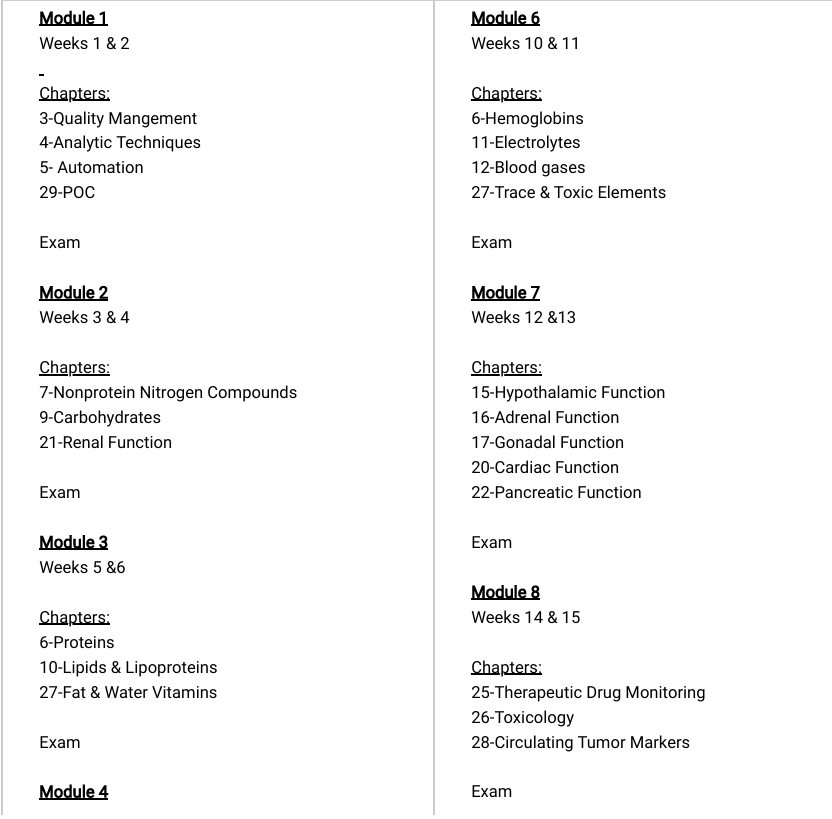
In each week's module will be listed the chapters you are required to read from your textbook - Clinical Chemistry: Principles, Procedures, Correlations, 9th Edition, by Michael L Bishop, Edward P Fody, & Larry E Schoeff.
There are additional website links available that you can refer to for additional information, if needed.
It might be helpful for you to review the pertinent information for each week's topics from the textbook, Clinical Laboratory Science Review, 4th Edition, by Jarreau.
Another source for a good review of all lab disciplines: Polansky, Quick Review Cards for Medical Laboratory Science, 2nd Ed, ISBN 9780803629561.
Presentations and Chapter Objectives:
The presentations are notes in "PDF" format and are to be printed or viewed online. It is recommended that if you are going to print them, in order to conserve on paper and ink, you should print multiple pages on one sheet, print on the front and back of page, and print in black and white. To do this:
Select the print key. At Page Scaling, select Multiple Pages per sheet. At Pages Per Sheet, select 6, or the number of pages per sheet you want. Then go to Properties and select to print on both sides of the paper (if your printer has that capability). Go to Color and print in Gray Scale.
The chapter readings from your textbook will be assigned in each week's module. Refer to the first page of each chapter for the appropriate objectives. Exam questions will be taken from the presentations and the required textbook readings.
Assignments:
The weekly assignments will be in word format and should be submitted in that format. They are always due on Sunday by 11:59pm (there may be exceptions, so be sure to check each week.) When you click on the assignment to access, some will have the name of the worksheet, while others will say "Click here for directions". Just click on either one and you will be able to download the document.
The Lab Assignments are under the "Lab" module for the appropriate week we have lab. These assignments include Lab Reports for each of the Chemistry tests you perform during lab on samples and Lab Study Questions, which are Multiple Choice questions. These questions might entail researching the web to find some of the answers.
Some weeks will have Discussion questions posted. The questions will either be assigned to specific students or statements/questions available for all to reply to. The answers will be available for everyone to view.
In order to see the comments that are entered onto your graded assignments, go to Submission details and then View feedback. Lots of feedback is given on the assignments which can help with clarification of understanding the material. Be sure to review it.
Labs:
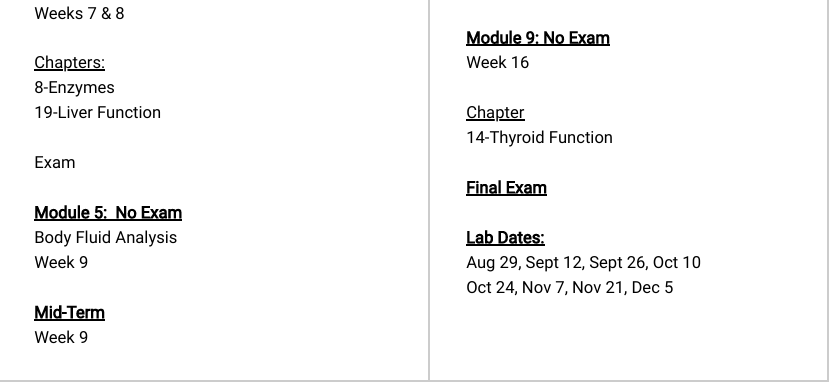
Labs are mandatory meetings on campus for all students. There will be a total of 8 lab sessions. Labs will meet in M139 1:00pm every other Tuesday and will start Week 2.
Lab procedures are from the analyzer's operation book - they will be provided in the Lab Manual (purchase from bookstore). Please read over the labs. The objectives on the lab will give you the information you need to know to complete the labs properly. These will also be covered on the exams.
The lab reports are due the Sunday after the lab session. There are Lab Study Question assignments also. They are available and due during the week that the corresponding reading material is covered. Some will be under the Assignments module and some will be under the Lab module for the appropriate week.
Exams:
There will be approximately 7 exams, 1 quiz and a final exam. Exams will start Week 3. The exams usually cover about 2 weeks of information. Exams will be available on Wednesday(12am) through Thursday(11:59pm) following the module. Please check the weekly modules for the exam due dates.
College Policies, Resources and Supports
For information related to the Student Code of Conduct Policy, Withdrawal Policy, Email Policy, and Non- Attendance/Non-Participation Policy, please review the college’s Code of Campus Affairs and Regulations webpage, which can be found at catalog.kcc.edu under the Academic Regulations & Conduct Guide.
KCC offers various academic and personal resources for all students. Many services are offered virtually, as well as in person. Please visit Student Resources - Kankakee Community College to access student resources services such as:
- Clubs and organizations
- Counseling and referral services
- Office of disability services
- Student complaint policy
- Transfer services
- Tutoring services, etc.
The materials on this course are only for the use of students enrolled in this course for purposes associated with this course. Further information regarding KCC's copyright policy is available at https://kcc.libguides.com/copyright.
|Course syllabus/calendar is subject to change.