
Room: L369 on Wednesday Evenings 6pm-830pm
This course will provide the student a rudimentary understanding of the expanding field of computer crime investigation. Through the examination of the operations and interrelationship of computers, software and the internet, the unique challenges, limitations, liabilities and goals of the computer crime investigator will be revealed to the student. Also addressed will be the emerging forensic science field of forensic computer examination.
LAWF 1733 or consent of instructor
This course will provide the student a rudimentary understanding of the expanding field of computer crime investigation. Through the examination of the operations and interrelationship of computers, software and the internet, the unique challenges, limitations, liabilities and goals of the computer crime investigator will be revealed to the student. Also addressed will be the emerging forensic science field of forensic computer examination.
Syllabus Disclaimer Course syllabus/calendar is subject to change.
Faculty Contact Information
Please either email me or call/text me to reach me so I can better assist you.
I have my Master's Degree in Public Administration. I recently retired from the Bradley Police Department after 23 years of service. During my career, I have worked on Patrol, as the School Resource Officer, in Investigations for 12 years, and ended my career serving as the Lieutenant that oversees Special Services for eight years.
I am currently working for the Kankakee County State's Attorney Office as an Investigator and Forensics Analyst.
I have always enjoyed teaching and take great pride in being available to my students when they need me. Although it is NOT mandatory, you are encouraged to reach out to me by cell phone as it is the quickest way for me to contact you.

Course Information
At the end of this course, students will be able to:
- Identify what constitutes a computer crime.
- Identify certifications available for forensic computer examination.
- Identify the unique traits of electronic evidence.
- Discuss the challenges to successful collection, storage and examination of electronic evidence.
- Discuss the relationship between investigators, forensic examiners, civilian experts and prosecutors engaged in a computer investigation.
- Discuss the role computers play in the exploitation of children.
- Explain the ECPA and PPA and how they effect computer crime investigation.
- Discuss the requirements and procedures for obtaining a subpoena and what information relating to computer crime investigation is available with this legal process.
- Discuss the type of hardware and software necessary for a forensic computer examination.
- Explain the process of a forensic computer examination.
- Identify the type of information obtainable through a forensic computer examination.
- Discuss the limitations of traditional law enforcement jurisdiction as it relates to the investigation of computer crime.
- Identify the unique aspects and challenges of computer crime investigation.
- Discuss the major goals of a computer crime investigation.
- Explain the necessary traits of a successful computer crime investigator.
- Explain the unique potential liabilities of a computer crime investigator.
- Discuss what constitutes a forensic computer examiner.
- Identify sources of computer crime investigation training.
- Identify resources available to the computer crime investigator.
Cybercrime (4th edition) by Catherine D. Marcum (ISBN# 979-8-8920-7426-1)
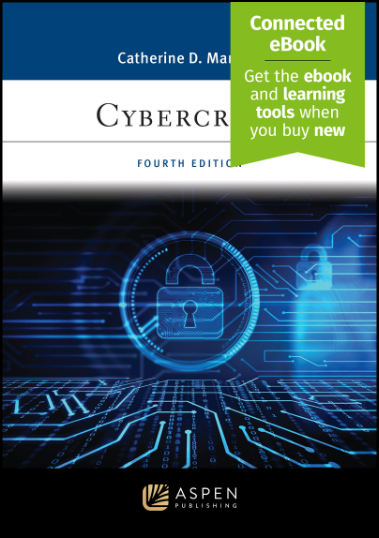
Cybercrime, Fourth Edition offers a comprehensive exploration of cybercrime in our society and the criminal justice system’s response. Investigating the dark side of our digital lives, this revision features contemporary examples of cybercrime activity for student examination and debate, active learning exercises for faculty use, and a strong focus on offending and victimization behaviors. Every chapter discusses key concepts, statistics, and legislative histories, ensuring readers are well-informed and prepared.
This book is not just a theoretical guide but a practical tool at the forefront of education. It will enlighten a broad audience, from those unfamiliar with the topic to individuals who need more specific information on a particular type of cybercrime. A valuable guide, this text equips students and academics with the knowledge to navigate the complex world of cybercrime.
New to the Fourth Edition:
- Discussions of deepfake usage and its impact
- New coverage of AI technology used to commit or detect crime
- Updates on new forms of nonconsensual pornography
- Updated statistics that reflect the latest data
- New case studies to encompass recent developments in the areas of:
- revenge pornography
- cyberbullying
- ransomware, hacking, and governmental relations
- terrorists’ use of social media
You can have access to professors who invest in your success, but you still need to be willing to do the work, even when it’s hard. If you can’t do it alone, remember that asking for help is part of doing the work.
Discussion questions, review of chapters in our assigned textbook and either a final research paper or student presentation at the end of the semester.
Classroom participation is strongly encouraged and contributes to your overall grade.
As a reminder, communication is the key to success in life so please keep me informed in the event of any issues you are having in our class and any late arrivals or missed classes.
Course Assignments/Examinations
This class will consist primarily of readings and seminal-style discussions. Students will pick an area of interest in Cybercrimes and prepare an overview of the topic they will share with students in class. Students will also complete a presentation with a partner on issues related to Cybercrimes or related issues in the news.
There will be either a midterm and/or final exam.
Class attendance/participation will make up 25% of the final grade.
A PowerPoint presentation related to Cybercrimes will make up 25% of the final grade.
Students will write one paper (3 - 4 pages maximum) on an issue related to Cybercrimes in the criminal justice system. This will make up 25% of the final grade.
A midterm/final exam will make up 25% of the final grade. The class will decide on what type of midterm/final exam they have.
Evaluation
Quizzes cannot be taken late. (Quizzes may be taken early)
Grading Scale
Attendance/ Participation 25 pts 100% - 90%= A
Presentation 25 pts 89% - 80% = B
Research Paper 25 pts 79% - 70% = C
Mid-term/Final Exam 25 pts 69% - 60% = D
Total Points 100 pts Hybrid classes only
Course Policies
Attendance (on time) at all scheduled class sessions is expected. Students must sign in to KCC Canvas and answer the quick “Attendance Discussion” question for weekly attendance credit and participate in class to receive points. Assignments must be submitted on time for credit.
A final grade of “F” will be given to anyone who consistently fails to attend, is late for, or leaves class.
Students are expected to complete all assigned readings before each class.
Students are expected to make arrangements to see the course instructor when they need assistance with the course. Please make an appointment or speak with the instructor before/after class or on a classroom break if possible.
Permission to make up an exam may be permitted by the instructor when an absence has been unavoidable and prior arraignments are made with the instructor.
All makeup work must be done outside of regular class time and must be completed within one day of the absence unless other arrangements are made prior to the end of the one-day limit.
Five points will be deducted per class day for taking exams late.
In the event extra credit is offered, students must submit all required course work on time, in order for the extra credit points to be included in the calculation of the student’s final grade.
Business, Technology & Human Services
Dean, Paul Carlson; 815-802-8858; V105; pcarlson@kcc.edu; Division Office – W102; 815-802-8650
College Policies
Withdrawals
When it is necessary to withdraw from a course or from college, a student may do so on or before the withdrawal date without receiving a punitive final grade. Students should use Change of Schedule forms which are available in Student Services. Students may submit a Change of Schedule form to Student Services or through the mail, but they must be postmarked no later than the withdrawal date. No withdrawals are allowed by phone. To determine the last date to withdraw with a grade of “W” in this course, log into KCConnect and click on “my registration statement” under Academic Profile.
Code of Conduct
Students need to adhere to the Code of Conduct located in the college catalog.
Email Policy
To ensure a student's privacy under all applicable education laws and to facilitate timely interactions, two College-authorized methods of electronic communication exist KCC-issued student email accounts (using the domain name of student.kcc.edu) and the Canvas Learning Management System. Students are expected to regularly check their KCC email accounts and Canvas for important incoming communication from the college or from individual instructors. Students understand that emails they send from personal email accounts (other than those listed above) may not be delivered to the KCC recipient, and students should have no expectation that such messages will be answered.
Non-Attendance/Non-Participation
KCC complies with state law and federal financial aid policy. If you receive an attendance grade of F or are institutionally withdrawn from a course, it will affect your eligibility for financial aid.
(1) You must attend at least one class or participate at least once in an online course (logging in without participation is not attending), by the 10th day of 16-week courses or within the first 10% of shorter-term classes. Non-attendance will result in an attendance grade of F.
(2) If you have excessive absences and no reasonable chance of passing the course at midterm (or after), your instructor may give you a WX grade and have you institutionally withdrawn from the course.
Cell Phone Policy
Since you are all adult students with jobs, full class loads, families, and other responsibilities that demand your attention, please be considerate to others in the class and excuse yourself for a brief call or other electronic communication so as not to disrupt the learning environment. Since we are in an online environment, please excuse yourself if need to attend to something outside of our class work.
Classroom Behavior Policy
Be respectful to others around you in the classroom as the goal is for everyone to be able to take away a little bit of knowledge in computer crimes while opening up your eyes to the future of technology and the pros and cons of its advancement.

College Policies, Resources and Supports
For information related to the Student Code of Conduct Policy, Withdrawal Policy, Email Policy, and Non- Attendance/Non-Participation Policy, please review the college’s Code of Campus Affairs and Regulations webpage, which can be found at catalog.kcc.edu under the Academic Regulations & Conduct Guide.
KCC offers various academic and personal resources for all students. Many services are offered virtually, as well as in person. Please visit Student Resources - Kankakee Community College to access student resources services such as:
- Clubs and organizations
- Counseling and referral services
- Office of disability services
- Student complaint policy
- Transfer services
- Tutoring services, etc.
The materials on this course are only for the use of students enrolled in this course for purposes associated with this course. Further information regarding KCC's copyright policy is available at https://kcc.libguides.com/copyright.
|Course syllabus/calendar is subject to change.